01
Chest discomfort or breathlessness linked to reduced blood flow
↗
A comprehensive catheterisation programme for coronary, structural, rhythm and peripheral vascular care.
Worried about cost? You'll get a written estimate before any planned procedure.
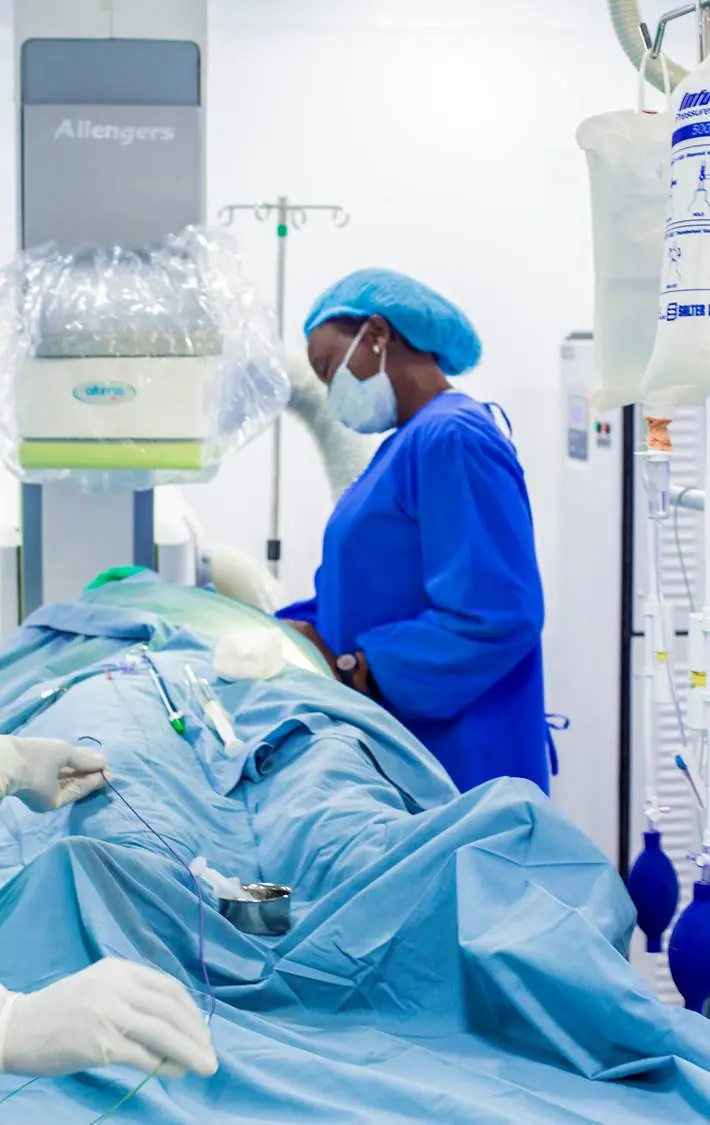
Cardiocare brings specialist assessment, advanced imaging, intervention and critical-care backup together in one Abuja heart centre. Our dedicated cardiac catheterisation laboratory supports diagnostic and therapeutic procedures, with each patient reviewed by the appropriate multidisciplinary team.
Catheter-based care uses small access points in a blood vessel to investigate or treat selected heart and circulation problems. The procedure itself is only one part of safe care: deciding who will benefit, preparing carefully, monitoring recovery and planning follow-up matter just as much.
Many catheter procedures are performed while the patient is awake, with local anaesthesia and a small access point. Suitability is individual, and Cardiocare keeps surgical and intensive-care expertise close when a more complex pathway is needed.
These are common starting points, not a diagnostic checklist. The right assessment depends on the full clinical picture.
Chest discomfort or breathlessness linked to reduced blood flow
↗An abnormal ECG, stress test, CT scan or echocardiogram
↗A suspected narrowing or blockage in a heart or peripheral artery
↗A clot-related or structural problem needing specialist review
↗A second opinion on stenting, surgery or another treatment route
↗Urgent assessment after a possible acute cardiovascular event
↗Every capability is selected according to clinical need. Your team should explain why a test, treatment or referral is being considered.
Diagnostic catheterisation images the coronary arteries and, where needed, the right or left heart chambers directly.
→Narrowed coronary arteries are opened with balloon angioplasty and, usually, a stent.
→Selected acute coronary syndrome cases are fast-tracked onto an urgent primary PCI pathway.
→Angiography, angioplasty and stenting extend to peripheral arteries beyond the heart.
→Renal and carotid angiography are available for selected patients whose vascular disease extends to these arteries.
→Temporary or permanent pacemakers are implanted to correct a slow or unreliable heart rhythm.
→ICDs and cardiac resynchronisation devices are implanted for patients at risk of dangerous rhythms or with weakened heart-pump function.
→Left bundle branch and other conduction-system pacing positions the lead along the heart's natural pathway for more physiological pacing.
→IVC filters may be placed to reduce the risk of a clot travelling to the lungs, and venography images the venous system when needed.
→Selected congenital and structural heart defects are closed using a catheter rather than open surgery.
→Every procedure includes assessment beforehand and monitored recovery afterwards, with ICU/HDU escalation if needed.
→Complex medicine feels more manageable when every stage is visible and every question has a place.
We connect symptoms, medical history and previous results before recommending an invasive test or treatment.
The team explains the purpose, alternatives, preparation, likely recovery and questions that still need answering.
The procedure is performed with continuous monitoring by an experienced catheterisation team.
The access site, heart rhythm, blood pressure and overall condition are observed after the procedure.
Medicines, risk-factor management, rehabilitation and follow-up help support long-term benefit.
A cardiac catheterisation laboratory is a specialised procedure room where clinicians use thin, flexible catheters and real-time X-ray imaging to reach the heart and blood vessels. Many procedures are performed with local anaesthesia while the patient remains awake or lightly sedated. The most important decision is not simply whether a procedure is possible, but whether it is the safest and most useful option for that patient.
Contrast and specialised imaging can show narrowing, blockage, abnormal connections and selected structural problems in the heart or blood vessels.
Catheters can record pressures and oxygen levels inside heart chambers and vessels, helping the team understand complex or congenital conditions.
Selected blockages may be opened with a balloon and stent. Other procedures can place heart-rhythm devices, filters or specialised equipment without a large surgical incision.
Not every condition should be treated in the cath lab. Cardiology, imaging and cardiac surgery review the findings so medicines, intervention and surgery are compared fairly.
These are common reasons to arrange an assessment. They do not confirm a diagnosis, and the appropriate starting team may change after clinical review.
Cardiocare brings the relevant specialists, investigations, treatment and follow-up into one documented plan.
Symptoms, examination, ECG, imaging, kidney function, medicines and allergies are reviewed before an invasive test is recommended.
→The team explains the purpose, possible findings, treatment options, access site, risks and the individual recovery plan.
→A catheter is guided through a wrist, arm or groin vessel while the team watches its position and continuously monitors the patient.
→If the agreed plan and findings support it, intervention may be performed during the same session or scheduled after heart-team review.
→The access site, rhythm and vital signs are monitored. Medicines, rehabilitation, device checks and risk-factor care support long-term benefit.
The strongest advantage is not one department. It is the ability to bring the right departments together quickly and safely.
When anatomy or long-term benefit favours surgery, the same hospital can move the case into a multidisciplinary surgical pathway.
Round-the-clock critical-care capability supports unstable patients and those needing closer monitoring after a procedure.
Nephrology, diabetology, laboratory and vascular care help manage contrast risk, wound healing, medicines and overlapping disease.
Go to the nearest emergency department immediately — do not drive yourself. Call our 24/7 emergency line on +234 806 142 4614 to tell us you are coming.
An experienced multidisciplinary team, a dedicated cath lab, cardiac surgery, ICU/HDU support and coordinated follow-up help us manage both planned and urgent cardiovascular cases. This is why patients, families and referring clinicians choose Cardiocare for care that may need more than one specialist or facility.
Consultation, diagnostics, intervention, surgery, ICU/HDU, dialysis and recovery can coordinate without fragmenting the patient journey.
Advanced catheter, device and surgical expertise—including Northern Nigeria’s first cardiac left bundle branch pacing—reflects a culture of clinical progress.
Round-the-clock emergency, ICU and HDU support surrounds patients whose needs may change quickly.
Cardiology works alongside nephrology, endocrinology, neurology, pulmonology, surgery and other specialists when one diagnosis is not the whole story.
International-level cardiovascular capability in Abuja helps families avoid unnecessary travel abroad and remain closer to their support system.
Plain-language teaching, patient guides, support programmes and professional education turn expertise into confidence.
Open each question for a straightforward explanation. Your own clinician should still interpret what it means for you.
Ask the Cardiocare teamNo. Results are interpreted with symptoms, examination and overall risk. Some people need medicines or monitoring, while others may benefit from intervention or surgery.
Many catheter-based procedures use local anaesthesia with light sedation rather than general anaesthesia. Your team explains the plan before consent.
It depends on the procedure, access site and your wider health. The team gives individual instructions about movement, medicines, wound care, work and follow-up.
The cath lab is connected to cardiac imaging, surgery, anaesthesia, ICU/HDU, laboratory and inpatient care, so the whole pathway is available in one centre.
Prepare questions, understand warning signs and revisit explanations at your own pace.
This page is educational and cannot diagnose a condition or determine which treatment is right for an individual. A clinician must assess symptoms, results, medicines and overall health. Severe or rapidly worsening symptoms need urgent care.
Emergency? Go to the nearest emergency department — do not drive yourself. Our cath lab is on standby 24/7.
Call 24/7: +234 806 142 4614