
Pacemakers: a patient’s guide
A pacemaker supports selected slow or unreliable heart rhythms.
When a pacemaker is recommended
A pacemaker is a small implanted device that monitors the heart's own electrical rhythm and delivers a tiny electrical impulse whenever the heart beats too slowly or pauses for too long, prompting a normal beat. It is recommended when the heart's natural electrical system can no longer reliably keep the heart beating at a safe rate on its own.
Normally, each heartbeat begins as an electrical signal from the sinus node (the heart's natural pacemaker, in the right upper chamber), spreads across the upper chambers, passes through a relay point (the AV node), and then spreads through the lower chambers, making them contract. A pacemaker is recommended when this pathway fails in one of two broad ways: the sinus node itself fires too slowly or unreliably (sinus node dysfunction), or the signal is delayed or blocked on its way to the lower chambers (heart block). A pacemaker consists of a small generator, usually placed under the skin below the collarbone, connected to one or more leads that sit inside the heart, sensing its rhythm and pacing it when needed.
Symptoms that may lead to a pacemaker being considered
These are useful clues to discuss with a clinician, not a checklist for diagnosing yourself — many are also caused by conditions that have nothing to do with the heart's rhythm.
- ●Fainting, or a near-fainting "about to black out" feeling, especially if sudden and without warning
- ●Unusual fatigue or reduced ability to exercise, sometimes mistaken for general unfitness or ageing
- ●Dizziness or light-headedness, particularly on standing or with exertion
- ●Breathlessness that is out of proportion to activity
- ●A pulse that feels, or is measured as, unusually slow or with long pauses
Is this an emergency?
Right now
- Fainting or collapse, especially without clear warning
- Severe breathlessness or chest pain alongside a slow or irregular pulse
- Confusion or profound weakness with a very slow pulse
Go to the nearest emergency department immediately — do not drive yourself. Call Cardiocare's 24/7 emergency line on +234 806 142 4614 (staffed around the clock) to tell us you are coming.
Call Cardiocare 24/7Book this week
New or worsening fainting spells, dizziness or unexplained fatigue — even without collapse — should be assessed within days rather than waiting for a routine slot.
Routine review
An already-diagnosed slow rhythm being monitored, or scheduled device checks once a pacemaker is in place, are routine — but new symptoms are not.
What causes the heart's rhythm to slow
- ●Age-related wear of the electrical system — the most common cause, as the sinus node or conduction pathways gradually become less reliable over decades
- ●Fibrosis or scarring of the heart's electrical pathways, from ageing or previous heart disease
- ●A previous heart attack, if it damaged tissue the electrical signal depends on
- ●Certain medicines, including some used to treat other rhythm problems or high blood pressure, which can slow the heart rate as a side effect
- ●Underactive thyroid or significant electrolyte disturbance
- ●Congenital conduction problems, present from birth, in a smaller number of patients
Who is more likely to need a pacemaker
- ●Increasing age
- ●Existing structural heart disease, such as a prior heart attack or heart failure
- ●High blood pressure — very common in Nigeria and often undiagnosed
- ●Diabetes
- ●A family history of conduction problems
- ●Certain heart surgeries or procedures that can affect the conduction system
How Cardiocare confirms a pacemaker is needed
The exact pathway depends on symptoms, examination and previous results. It typically draws on some or all of the following:
- 01History and examination. When symptoms happen, their pattern, and an examination of your pulse and blood pressure.
- 0212-lead ECG. A painless recording of the heart's electrical activity that may directly show a slow rhythm or conduction block.
- 03Holter or extended rhythm monitoring. A portable ECG recorder worn for a day or longer, since brief pauses or slow spells must be caught in the act to be confirmed.
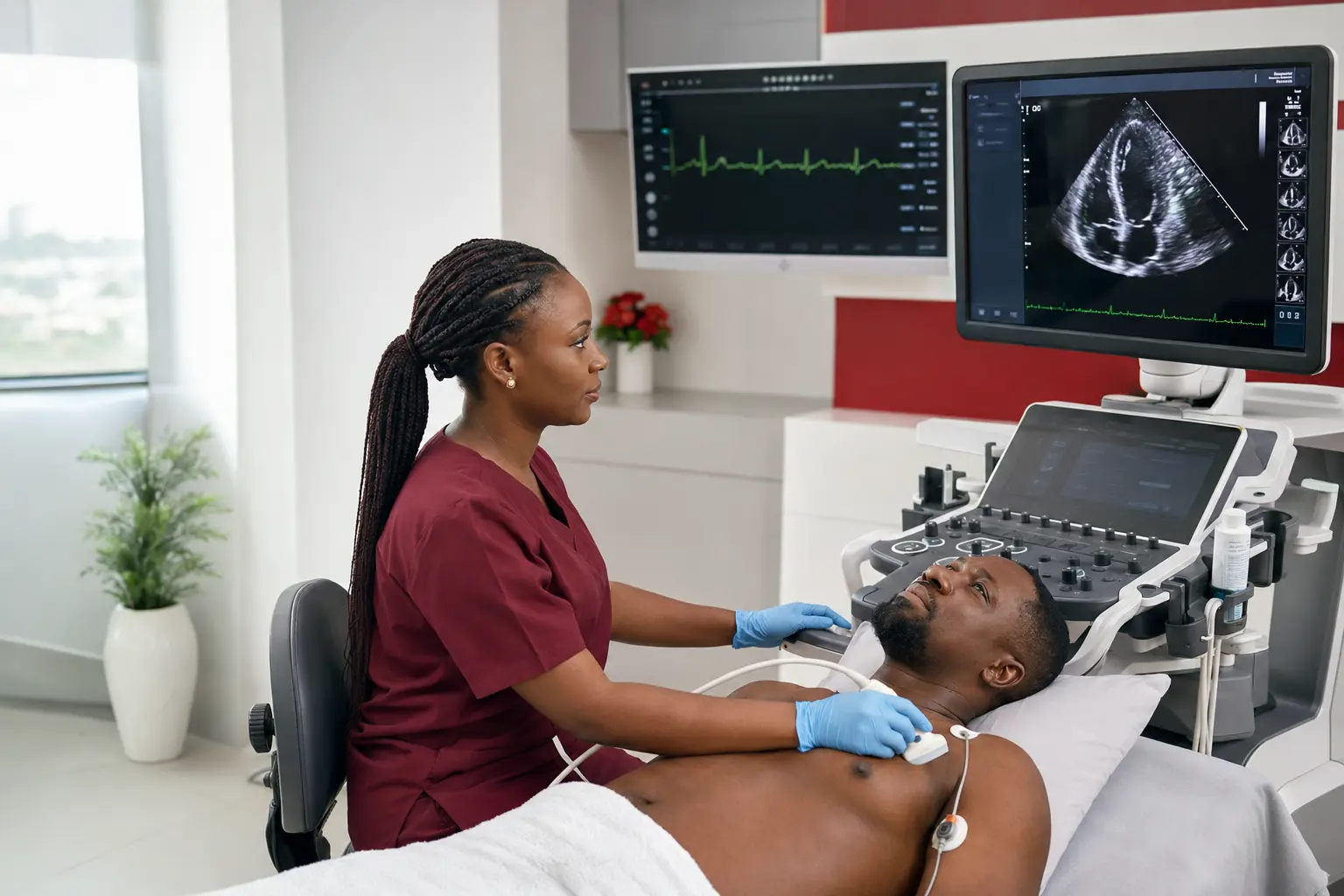
- 04Echocardiogram. A painless ultrasound scan of the heart's structure and pumping function, to look for an underlying cause and guide device choice.
- 05Blood tests. Thyroid function and electrolytes help rule out reversible causes of a slow rhythm.
Types of pacemaker
The right type depends on which chambers need support and why:
- ●Single-chamber pacemaker — one lead, usually pacing the lower right chamber, for selected patients whose upper-chamber rhythm remains reliable
- ●Dual-chamber pacemaker — two leads, coordinating the upper and lower chambers to work together, the most commonly used type
- ●Leadless pacemaker — a small self-contained device placed directly inside the heart without a separate chest incision or lead, suitable for selected patients
- ●Cardiac resynchronisation therapy (CRT) — a specialised multi-lead device for selected patients whose heart failure also involves the two lower chambers beating out of coordination
The implantation pathway
The pathway on the day and afterwards typically includes:
- 01Rhythm and clinical assessment. A final check confirms the plan and answers any last questions before the procedure.
- 02Implantation in a procedure room or cath lab. Performed under local anaesthetic with sedation, a small incision is made below the collarbone, the lead or leads are guided through a vein into the heart, and the generator is placed in a small pocket under the skin.
- 03Post-procedure ECG and wound review. Confirms the device is working correctly and the incision is healing as expected.
- 04Programming and scheduled interrogation. The device is programmed to your individual needs, and a follow-up check is scheduled to review how it is performing.
Living with a pacemaker
- ✓Keep the device identification card the team gives you — it confirms the make and model for future reference
- ✓Attend every scheduled device check, even when you feel entirely well
- ✓Follow wound and arm-movement guidance carefully in the weeks after implantation
- ✓Tell clinicians, dentists and airport or venue security staff about your device
- ✓Most people return to normal daily activities once healed — see our fuller guide to living confidently with a pacemaker for day-to-day detail on exercise, travel and electrical equipment