
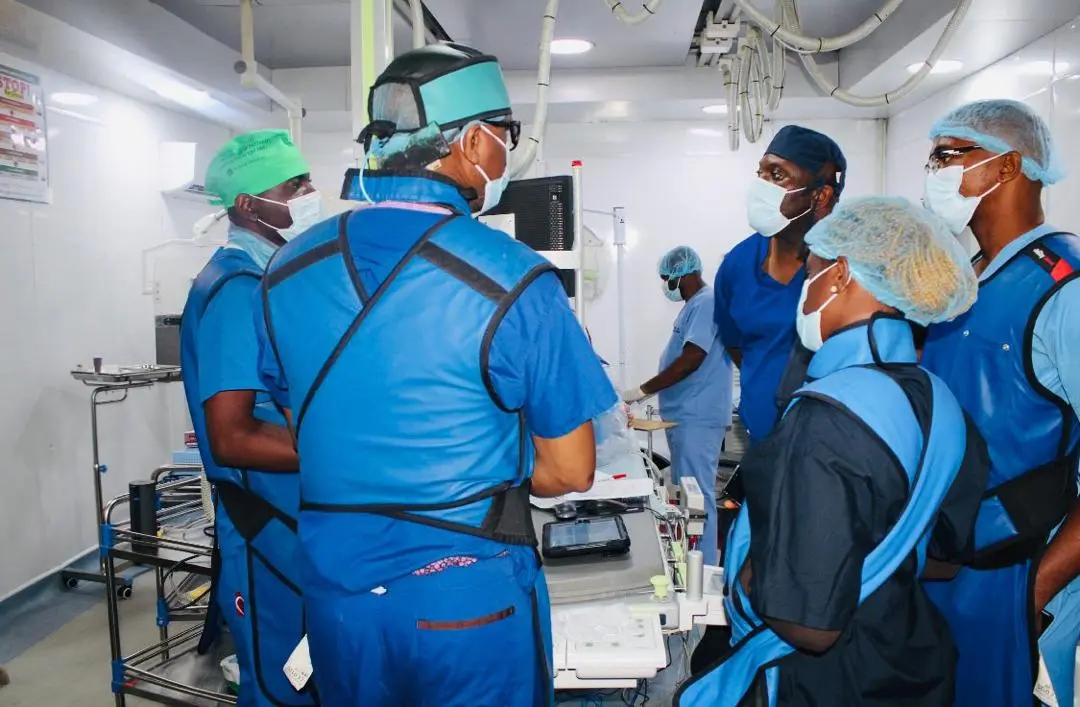
What happens in a cardiac catheterisation laboratory?
A cath lab is a specialised procedure room for minimally invasive heart and blood-vessel tests and treatments.
Understanding the cardiac catheterisation laboratory
A cardiac catheterisation laboratory — usually called a "cath lab" — is a specialised procedure room where the cardiology team examines and treats the heart and blood vessels from the inside, using thin, flexible tubes called catheters instead of open surgery.
A catheter is guided through a blood vessel, usually entering at the wrist or the groin, and threaded carefully towards the heart under continuous real-time X-ray imaging. Once in place, it can do several different jobs depending on why you were referred: injecting a contrast dye to create detailed moving pictures of the heart's arteries or chambers, measuring pressures inside the heart, opening a narrowed artery with a small balloon and usually a stent, placing a heart-rhythm device, or supporting other cardiovascular treatments. The room itself combines imaging equipment, physiological monitors and a sterile working area, staffed by a team including a cardiologist, nurses and technologists throughout.
Many cath lab procedures use only local anaesthetic at the entry site rather than a general anaesthetic and a large surgical cut, which is why recovery is often quicker than open surgery. That does not make them minor, though — every patient still needs careful selection, informed consent, and monitored recovery afterward.
When you may be referred to the cath lab
- ●A recommendation for coronary or peripheral angiography, to see where an artery is narrowed or blocked
- ●A possible angioplasty, stent placement, or heart-device procedure
- ●A congenital heart question, pressure measurement, or structural heart problem needing closer assessment
- ●A second opinion comparing catheter-based treatment with surgery
How to prepare
- ✓Ask what specific question the procedure is meant to answer
- ✓Share all allergies, kidney problems and every current medicine, including herbal and over-the-counter products
- ✓Follow fasting and medicine-pause instructions exactly as given — some medicines, particularly blood thinners and diabetes medicines, may need adjusting beforehand
- ✓Arrange for someone to bring you and take you home — you should not drive yourself afterward
- ✓Plan for the possibility of an overnight stay, even if a same-day discharge is expected
What happens on the day
You will usually be admitted a few hours beforehand for final checks, consent, and preparation of the entry site (most often the wrist, sometimes the groin), which is cleaned and shaved if needed.
In the cath lab, you lie on a procedure table under continuous heart monitoring. A local anaesthetic numbs the entry site before the catheter is introduced — you should feel pressure rather than sharp pain at this point. Light sedation is often given to help you relax, though most patients remain awake and can talk to the team throughout. You may feel a brief warm flushing sensation when contrast dye is injected; this is normal and passes quickly. The procedure itself commonly takes well under an hour, though this varies with what is being done.
Afterward, pressure is applied to the entry site (sometimes with a small closure device at the groin), and you are moved to a recovery area for monitoring of your heart rhythm, blood pressure and the access site before you are cleared to go home or to a ward.
How Cardiocare prepares and assesses you
The exact pathway depends on your symptoms, examination, previous results and overall health. It typically includes:
- 01Clinical and medicine review. Checking your history, current symptoms and every medicine you take.
- 02Kidney function and blood count. Because contrast dye is processed by the kidneys, and bleeding risk needs assessing beforehand.
- 03ECG, echocardiography, CT or other imaging where indicated. To build a full picture before the procedure.
- 04Heart-team discussion for complex disease. Selected cases are reviewed by specialists together to compare catheter treatment, surgery, and medical management.
Is this an emergency?
Right now
- Severe chest pressure, collapse or sudden major breathlessness
- After a procedure: heavy bleeding, a rapidly swelling access site, fainting, or a cold, pale or painful limb
- Fever with chills after discharge
Go to the nearest emergency department immediately — do not drive yourself. Call Cardiocare's 24/7 emergency line on +234 806 142 4614 (staffed around the clock) to tell us you are coming.
Call Cardiocare 24/7Book sooner
Contact the team promptly for gradual increase in bruising, mild persistent oozing at the access site, or new symptoms that worry you but do not match the emergency list above.
Routine review
Mild bruising and tenderness at the access site that is settling as expected can usually be discussed at your scheduled follow-up.
Risks and recovery
Every procedure carries risk. Knowing them, and the recovery path, is part of safe, informed care.
Common, usually minor
- Bruising or a small lump at the wrist or groin access site
- Mild discomfort where the catheter entered
- A small amount of bleeding under the skin (a haematoma)
Rare but serious
- An allergic-type reaction to the contrast dye used for imaging
- Damage to the blood vessel at the access site needing further treatment
- A rare heart attack or stroke occurring around the time of the procedure
- An uncommon strain on kidney function from the contrast dye, more likely if kidneys are already strained — we check kidney function first
Preparing well
- Tell the team about all medicines, allergies and any previous reaction to contrast dye
- Follow fasting instructions exactly as given
- Arrange for someone to take you home — you should not drive yourself
- Ask which regular medicines to take or pause on the day
Recovery timeline
- Many cath lab procedures are day-case, occasionally with one overnight stay; more complex procedures need longer
- Light activity can usually resume the next day, as advised
- Heavier lifting and strenuous exercise are usually avoided for a period after the access site is used
- Results and next steps are discussed at a follow-up review
Preparing for your appointment
What to bring
- ✓A list of all medicines you take, including herbal and over-the-counter preparations
- ✓Any previous ECGs, echocardiograms or hospital letters
- ✓Your HMO card and a valid means of identification
- ✓Contact details for the person bringing you home
What we will ask
Your symptoms and how they affect you, your full medicine and allergy history, any kidney problems, and any previous reaction to contrast dye or anaesthesia.
Questions worth asking us
- ●What exactly will this procedure show or treat?
- ●What are the alternatives, including not having the procedure?
- ●How long will I need to stay, and what will recovery involve?
- ●When and how will I get my results?