
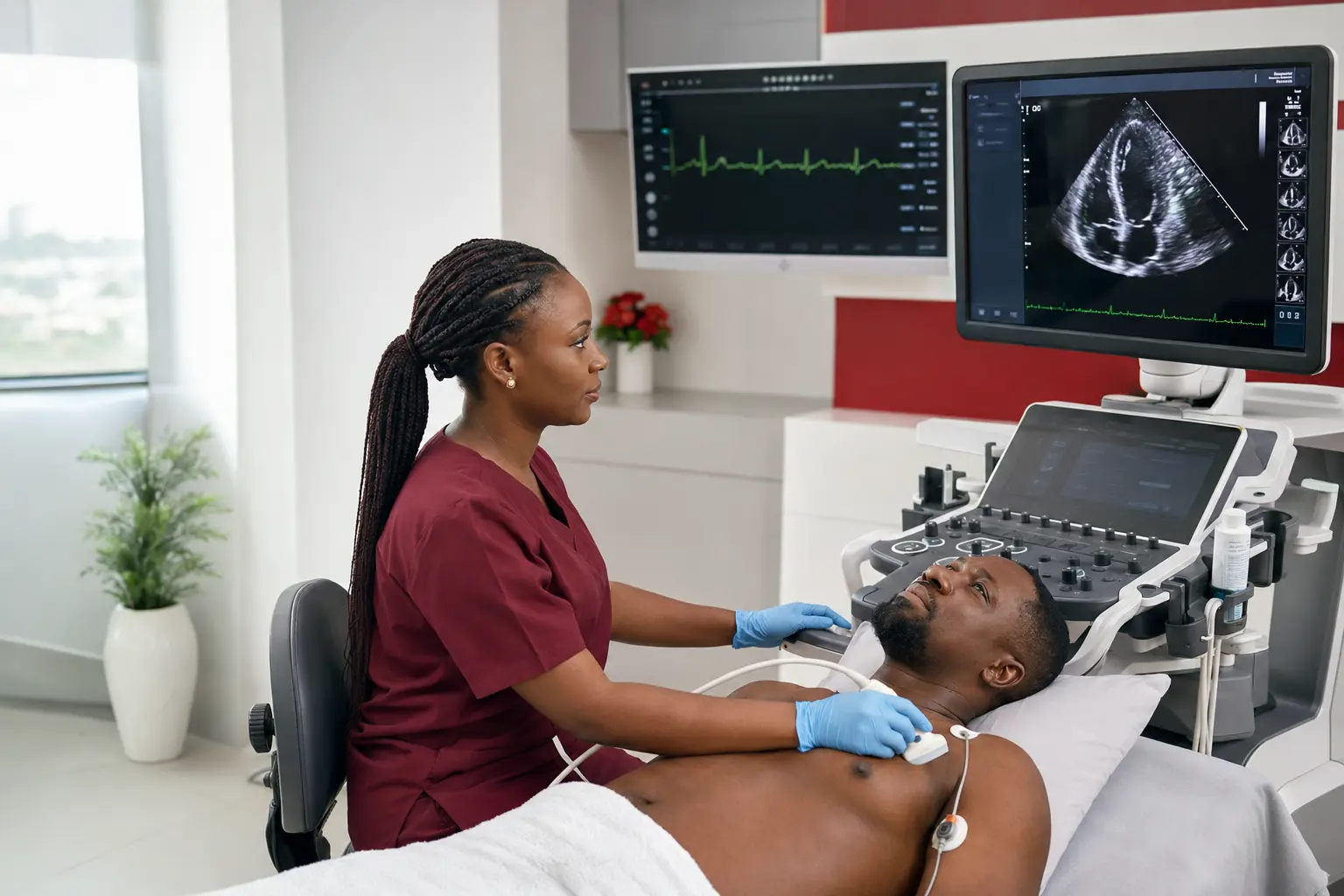
Holter monitoring: recording your rhythm at home
A Holter monitor records heart rhythm during normal daily activity.
Understanding Holter monitoring
A Holter monitor is a small, portable ECG recorder that you wear for a day or longer to capture your heart's electrical activity during ordinary daily life — not just the few minutes of a clinic visit.
A standard ECG (electrocardiogram) records the heart's electrical signal for only a few minutes in the clinic. That is enough to catch a rhythm problem happening at that exact moment, but many rhythm problems come and go — a normal ECG taken while you feel fine does not mean nothing is wrong; it means the rhythm was normal at that moment. A Holter monitor solves this by recording continuously for much longer, so if palpitations, dizziness or fainting happen while it is worn, the recording shows exactly what the heart's rhythm was doing at that time.
The device itself is simple: a small box, roughly the size of a mobile phone, connected by a few thin wires to sticky electrode pads on your chest. It stores every heartbeat electronically for later analysis rather than transmitting anything in real time, so nothing about wearing it is urgent or alarming — it is simply gathering information for your cardiologist to review once it comes off.
When this test is recommended
Your clinician may suggest Holter monitoring to:
- ●Connect symptoms such as palpitations, dizziness or fainting with what the heart's rhythm is actually doing
- ●Check whether treatment for a known rhythm problem is working
- ●Look for silent, symptom-free episodes of an irregular rhythm, such as atrial fibrillation
- ●Assess heart rate control in someone with a known arrhythmia
The recording period is chosen for your situation — it may run for a single day or extend over several, depending on how often your symptoms occur and what question the test needs to answer. If symptoms are frequent, a shorter recording is often enough; if they are occasional, a longer period improves the chance of catching one.
How to prepare
There is little special preparation for Holter monitoring, but a few things help the recording succeed:
- ✓Bathe or shower before your appointment — you usually cannot get the electrodes wet while wearing the device
- ✓Wear a loose-fitting top that is easy to remove or lift for electrode placement
- ✓Avoid applying oils, lotion or powder to your chest on the day
- ✓Bring your usual medicine list, and continue taking your medicines unless told otherwise
What happens on the day
A member of the cardiac diagnostics team cleans small areas of your chest and attaches several small, sticky electrodes, each connected by a thin wire to a lightweight recorder that clips to your belt or hangs on a strap. The whole fitting takes only a few minutes and is not painful, though the skin may feel slightly tender when the electrodes are removed later.
You then wear the monitor for the period your clinician has prescribed, going about your normal day — work, prayer, light exercise, sleep — unless told otherwise. You will usually be given a diary to note the time of any symptoms and what you were doing when they happened; matching a symptom to the exact rhythm recorded at that moment is often the single most useful piece of information the test provides.
Wearing the monitor day to day
- ✓Keep the monitor and electrodes dry unless your team says otherwise — avoid showers, swimming and heavy sweating while it is fitted
- ✓Continue normal, safe activity; you do not usually need to change your routine
- ✓Keep the recorder away from strong magnets and avoid knocking it, but everyday phone and appliance use is not a concern
- ✓Write down every symptom, however brief, with the time and what you were doing
- ✓Not every symptom you feel will turn out to be caused by a rhythm change — that is useful information too
- ✓Return the equipment and diary at the scheduled time so the recording can be analysed
Getting your results
Once the monitor is returned, the recording is downloaded and analysed. This typically follows a set path:
- 01Device fitting and instructions. Electrodes and recorder are fitted, and you are shown how to keep a symptom diary.
- 02Continuous rhythm recording. The device records your heart's electrical activity throughout the prescribed period, day and night.
- 03Symptom–rhythm correlation. Your diary entries are matched against the recording to see what the rhythm was doing at each symptom.
- 04Cardiology interpretation and next-step plan. A cardiologist reviews the full recording and discusses the findings and any next steps with you.
If no symptoms occurred during the recording period, the test still has value — it shows what your rhythm does during a representative stretch of normal life, even without capturing the exact symptom. If symptoms are infrequent, your clinician may suggest a longer-duration or event monitor next.
Is this an emergency?
Right now
- Chest pain or pressure while wearing the monitor
- Fainting or a near-fainting "about to black out" feeling
- Severe breathlessness
- A fast heartbeat that stays fast and does not settle
- Collapse
Do not wait for the monitor result. Go to the nearest emergency department immediately — do not drive yourself. Call Cardiocare's 24/7 emergency line on +234 806 142 4614 (staffed around the clock) to tell us you are coming.
Call Cardiocare 24/7Book sooner
Contact the team promptly if the recorder or electrodes become detached, damaged or wet before the recording period ends, or if you are unsure how to complete your symptom diary.
Routine review
Mild skin itching under an electrode, or a brief adjustment period wearing the recorder, can usually be discussed at your results appointment.
Risks and after the recording
Holter monitoring is a low-risk test, but it is worth knowing what to expect:
- ●Mild skin irritation or redness where the electrodes were attached, which usually settles within a day or two
- ●Slight discomfort when adhesive electrodes are removed
- ●A rare skin reaction to the electrode adhesive in people with sensitive skin — tell the team if you have known adhesive allergies
- ●No sedation, needles or radiation are involved, and there is no recovery time needed once the monitor is removed
Preparing for your appointment
What to bring
- ✓A list of all medicines you take, including herbal and over-the-counter preparations
- ✓Any previous ECGs or cardiac test results
- ✓Your HMO card or payment details
- ✓A valid means of identification
What we will ask
What symptoms prompted the test, how often they occur, how long they last, and what you are usually doing when they happen.
Questions worth asking us
- ●How long will I need to wear the monitor?
- ●Can I bathe, exercise or sleep normally while wearing it?
- ●How and when will I get my results?
- ●What happens if my symptoms don't occur during the recording?